
5 Book Anti-Recommendations
Books I didn't like, and why I didn't like them.

There is an entire genre online of giving out books recommendations. I’ve done my share of this sort of thing: I got my start on YouTube making, essentially, lists of books that I liked. I still publish a series of book recommendations on Substack, though I have considerably slowed down the pace. Eventually, it becomes stale. But why? In theory, you could create this sort of content forever — keep reading and finding books you like, and then recommend them once you’ve reached some critical mass. If you read 100 books a year, it isn’t hard to imagine at least 25 of them being worth recommending, so you’d have at least 5 articles or videos (or one very long article/video). But inevitably, interest and enthusiasm fades from both the creator and the audience.
Some people never catch on. They try to find new hooks (TEN FANTASY BOOKS WITH EPIC AND BLOODY BATTLES, e.g.) or they try to repackage their old recommendations. I did this a bit, too, before I realized what the problem was. The problem is that people don’t look for book recommendations simply because they want to know about some books that might be worth reading; they like book lists because they reveal something about the maker of the list; in other words, book recommendations are a way to get to know a stranger you met on the internet.
It is the same reason we browse someone’s bookshelf when we’re at a party. We aren’t going to read the books on the shelves. That would be terribly rude. We’re sizing the person up, seeing if our tastes or interests align in some way. I always look at the shelves when I first get to the party, before the wine has loosened me up a bit and I’m ready to make small talk. I’m hoping that one of the books will help spark a conversation.
An example: at a writers’ meetup I go to in Austin, our host has stacks of books over her mantle. She’s older – I think she’s in her eighties – but she makes an effort to keep apprised of the big releases. Often, she has a book or two near her chair that someone at the meetup just published. If I can find one of these books, I have a way to talk to one of my fellow writers, perhaps someone I haven’t yet gotten to speak with. One particularly famous attendee (let’s just call him Mr. W) is someone I’ve longed admired; I’ve never had the nerve to speak to him; he’s the only one in the room I’m starstruck by. Once I see his new book on the mantle, though, I’ll be ready to have a conversation.
But looking at those books also tells me a lot about our host. I know that she doesn’t read much history or the big, trendy Big Idea books you see discussed on, say, NPR. She loves memoir and literary fiction. I can even get a sense of her sense of humor from her stacks of books. Her books tell me who she is.
When someone comes to my house, I let them browse the shelves on their own for a time, but eventually I join them. I point out a book I think they’ll like. I ask if they recognize anything. The principle is the same: I’m trying to get to know them. I’m letting them get to know me.
Two years ago, I had an idea for a video. It was going to be called something like ‘The worst books I’ve ever read.’ I opted not to make the video because I think, in general, you should talk about the things you like rather than the things you hate. If you’re going to talk about the things you hate, you should have a very good reason to do so. And the truth is, YouTube is not conducive to that sort of discussion. It would be a good way to become ‘toxic’, as we all now say, and toxicity spreads quickly.
On top of that, that title is almost painfully algorithm-friendly. It has a superlative and it promises to give you all the negatively charged content you desire. That’s not what I wanted to do on my channel, nor is it what I want to do here. The question is: how can you talk about books you hate (or at least dislike) without falling into that trap?
That’s the balance I’m trying to strike in this piece. These are my anti-recommendations. They are books I read and didn’t like, or tried to read and gave up on. I’m sharing these not because I want to talk about how awful they are, but because what someone doesn’t like can also reveal a lot about them. So, I hope you take it in that spirit. The point is to let you get to know me a bit more.
You may even like some of these books — if so, let me know. I always strive to be fair, but some of these books have become totems in my mind, standing in for the sort of writing and sort of thinking I loathe.
This article, along with most of my writing, is free. But for $8 per month, you can support my work on Substack and YouTube. You’ll be helping me continue to run philosophical reading groups and make videos on important ideas, and you’ll even help me pay my mortgage. Thank you for reading.

Everyone told me I would love Pillars of the Earth. The book sold fabulously well – it was a sleeper hit for Ken Follett, but it made his career into what it is today – and so it has many adoring fans. I was told that the book was slow and dry; this was meant as a warning, but I like books that are slow and dry. So, I bought a copy and gave it a go recently.
It now sits on my shelf unfinished. I’m considering putting it in my Little Free Library, where I’m sure it will be snatched up quickly — all the popular books get taken, while my extra copies of Byung-Chul Han sit there.
The book is oddly paced. The chapters are long, which usually indicates a slow pace, but an awful lot happens on every page. In one chapter, a character is fired from a job, travels the country with his family, tries to find work at a cathedral, fights off robbers (twice), loses his wife in childbirth, buries her, abandons his newborn due to his inability to care for it, changes his mind, goes back and finds that the baby has been taken in by monks. He also meets a woman who lives in a cave with her own son, falls in love with her, and asks her to marry her. It is frenetic! I had no time to sit with the character at all. I had no time to process my emotions, because he had no time to process his emotions. He moved from one moment to the next, and while plenty of dramatic things happened, I never seemed to care. When I saw that the second chapter had a similar pacing, I gave up.
On top of that, the book seemed remarkably modern in its depiction of emotions. These are not medieval people doing medieval things in a medieval world. They are modern, late-twentieth-century people who happen to be (eventually) building a cathedral. I felt no sense of immersion in history, something I look for in historical fiction.
The prose were acceptable but far from interesting. The early plot hooks failed to hook me. But above all, I did not care about the characters in their struggle; Follett failed to make me care. I cannot give this book a full review, because I did not finish it, but the above was plenty to make me put it down.
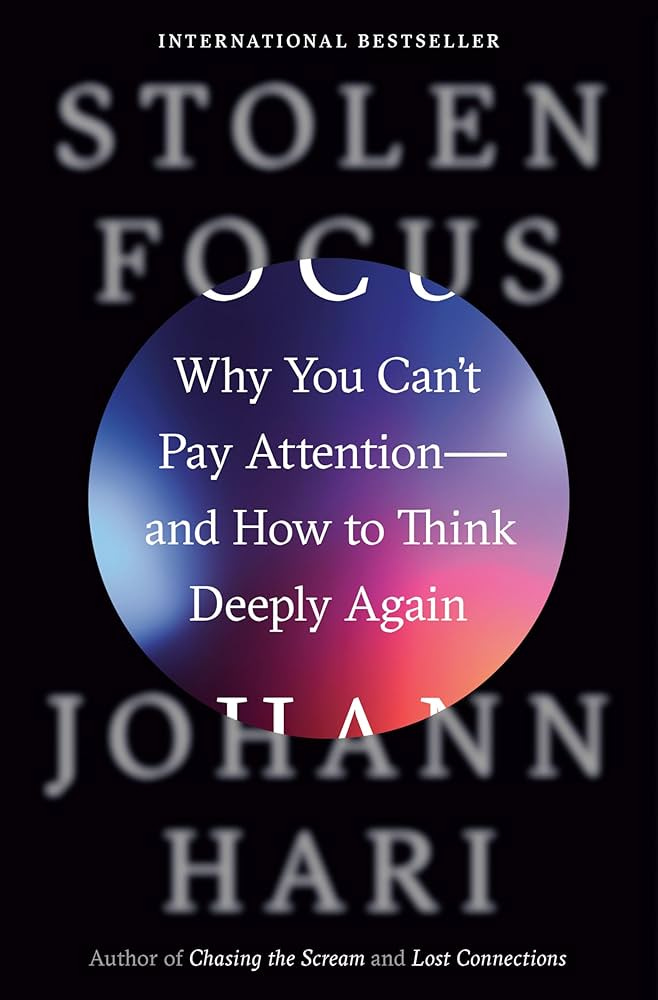
I hesitated to write about Stolen Focus at all, because I am writing a book that is on a similar subject. Given that my current project is about – it was described by The Bookseller as a ‘guide to cultivating a life of the mind “in an age of distractions”’ – writing negatively about Stolen Focus can seem like I am trying to ‘take down’ a competing title. But given that Stolen Focus was published in 2022, was picked by Amazon as a Book of the Year, and sold fabulously well, I think my negative comments won’t have much of an effect.
Hari is a journalist — fine, so far as it goes. But the thing about writing about attention and deep thinking is that the form needs to match the content. It should take some work. Hari’s book is full of references to studies (though very rarely are they cited directly or included in the bibliography), vignettes from interviews and his travels, and memorable lines, but the book felt too easy. Each chapter explored some aspect of declining attention spans, but it took for granted that attention mattered. It took for granted that we all understood what was at stake. (One exception, but unfortunately not enough to make up for the rest, was the discussion of mind-wandering. That wasn’t bad!)
That is exactly the problem I am trying to avoid in my writing. I don’t know if I am succeeding, but I am trying. I want to make the case for the life of the mind, not just rail against declining attention spans. (I do this throughout, but I have one chapter of roughly 9,000 words on just this issue: what the life of the mind gives us.) I want to show why this sort of life matters. If I did not do that, I would simply be repeating back what we all already take for granted.
This is why the model for my book is not Stolen Focus, but rather Hannah Arendt’s The Life of the Mind. Arendt never takes anything for granted. Every assumption, no matter how impressive its pedigree, is questioned. Philosophers from across history are drawn upon. At the end, a new vision of the subject is presented, but only after considering what so many others have said before. Will I produce a work as fine as Arendt’s? I doubt it. But aiming for Arendtian quality is a worthy pursuit.
Hari himself is not solely to blame. This style of book is very popular, but the weakness of the form are becoming more apparent. I worry that in writing a book about thinking, it did what an awful lot of books do: it gives the appearance of thought, but it never gives you the real thing.
I’m going to let you in on a little secret: almost everything I write is projection. When I talk about the problems of distraction, I’m really talking about the fact that I’m mad at myself for being so distractible. When I talk about reading, it is to remind myself that this is what I think is worth doing. Almost all of my work on YouTube and Substack is a product of this projection.
I am not a productivity guy — in fact, I now believe that productivity culture is a malignant growth, that it needs to be excised before it consumes the host. I believe this because I used to be a true believer. I used to read productivity books, try to build a second brain using the latest apps, and try to create perfect systems for being insanely productive. I saw how bad it was from the inside, as someone who has spent hundreds, perhaps even thousands, of dollars on this stuff.
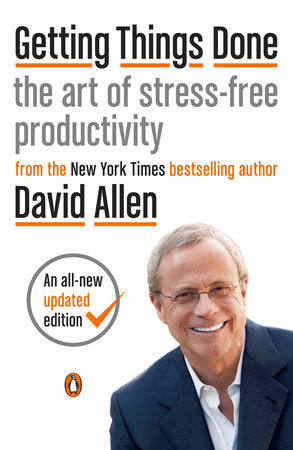
The ur-text of productivity culture is Getting Things Done. It is the book that led to a thousand other books. In some ways, it led to my own book, but as a response. It may be my ultimate anti-recommendation.
The truth is that most productivity advice can be lumped into two categories: common sense and bullshit. Getting Things Done is mostly the former, from what I can remember. If you are drowning in emails, meetings, and tasks, it might help you. And I don’t think it is nearly as bad as the books that followed in the productivity space. Yet, I look at it as the start of something awful. It was a response to our widespread feeling of being overwhelmed by work, and it said You can handle it. You can handle it, in fact, by implementing one more system. Add another layer of work on top of your work, and suddenly you’ll be able to work even more. It does not question its own premises.
I worked my way backward through the productivity canon, and so I read Getting Things Done when I was already becoming disillusioned with the whole pursuit. It felt hollow; it left me feeling hollow, too.
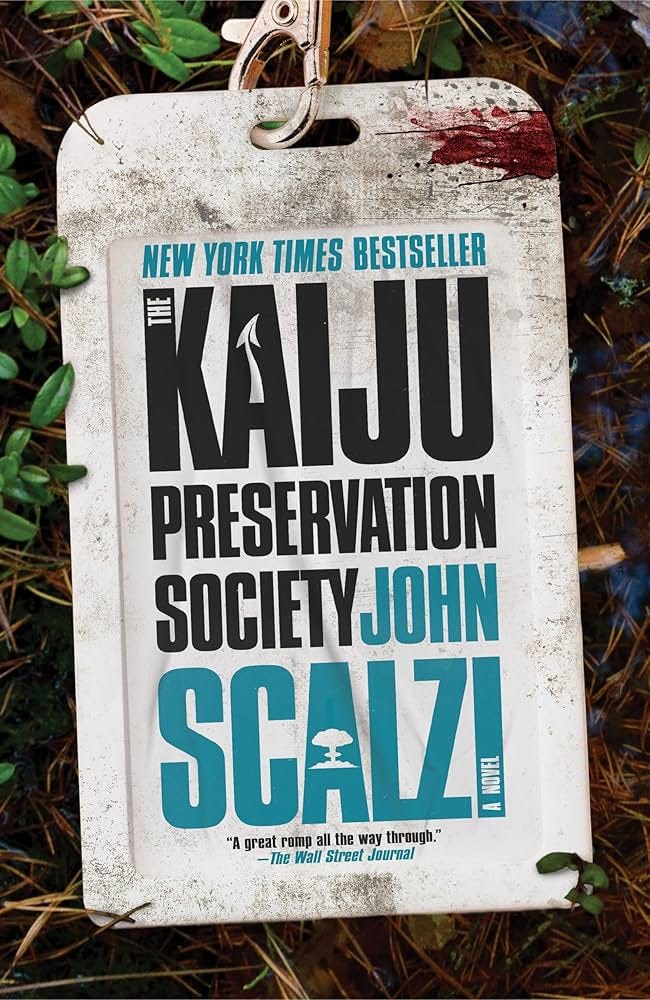
John Scalzi is a legend of contemporary science fiction. His books sell well, and he has a legion of devoted fans. I’ve heard Red Shirts is a fun book, though I haven’t read it. My first experience with Scalzi was The Kaiju Preservation Society. It will also be my last experience with Scalzi.
Here’s why: Scalzi is a snarky writer, and I’ve come to hate snark. Even when the snark is used in service of something the writer earnestly believes (in Scalzi’s case, his personal politics), it grates. Snark is a way to present facts as if they are obvious, to make caricatures of competing perspectives, to signal to your in-group that you are really, definitely in that in-group. Snark was the dominant mode of writing when I was in college; the internet was full of snarky Millennials (or Gen Xers writing for Millennials). Irony, detachment….it was the only way we communicated. You could make a career being snarky, and people would love you for it. But at some point, you have to go beyond the snark. There has to be a heart to the story, or to you as a person, and I didn’t feel any of that in Scalzi’s writing.
I contrast Scalzi with someone like Terry Pratchett. Pratchett was an absurdist, and he probably could be called snarky at times. But the Discworld novels are also very tender and emotional at times. Does Scalzi do this elsewhere? He might! But he didn’t do that here.
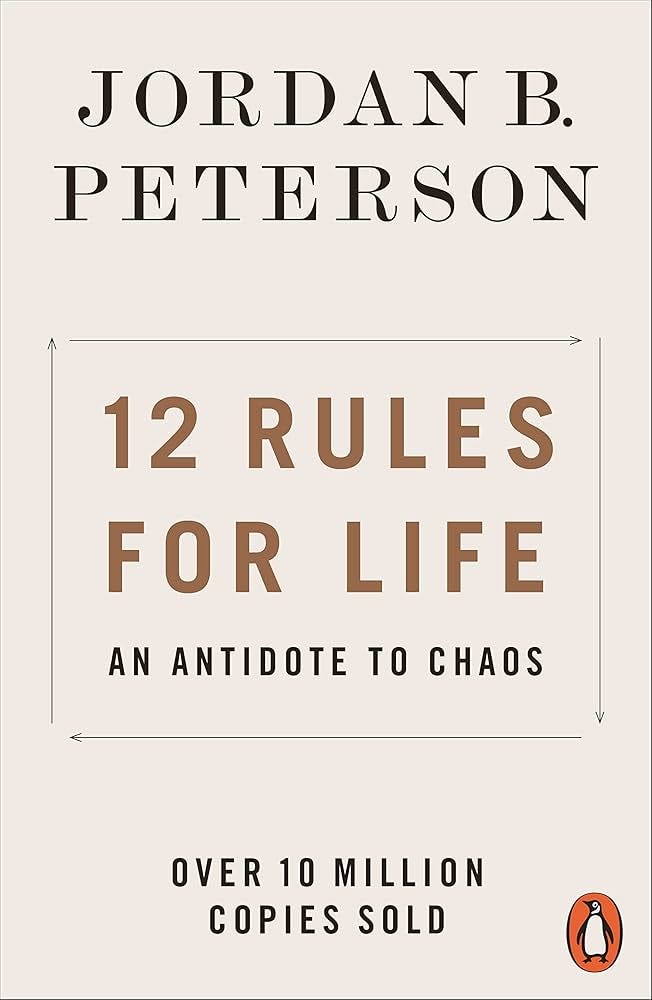
Jordan Peterson is perhaps the most famous public intellectual in the world. As such, everyone is expected to have a view of him. Even now, as you read this, some of you are getting ready to tell me what your view. Maybe it is an insult to the term ‘public intellectual’ to use it as a description for Peterson, or maybe Peterson is a misunderstood prophet, or maybe he truly is the best thing ever. I’ve managed to go many years without publicly stating my view of Peterson, and that’s because I don’t really have one. He exists. I am aware of his existence. That’s about it.
Nevertheless, I know a lot of people for whom reading or otherwise encountering Jordan Peterson was a life-changing experience. Many of these people I call friend. I have never seen the appeal of Peterson, and from what I can tell he has gone down strange rabbit holes in more recent work (see Rowan Williams’ review of his latest book). But I wanted to see what all the fuss was about, so I read 12 Rules for Life.
The basic advice Peterson gives is found in the twelve rules:
“Stand up straight with your shoulders back.”
“Treat yourself like someone you are responsible for helping.”
“Make friends with people who want the best for you.”
“Compare yourself to who you were yesterday, not to who someone else is today.”
“Do not let your children do anything that makes you dislike them.”
“Set your house in perfect order before you criticize the world.”
“Pursue what is meaningful (not what is expedient).”
“Tell the truth – or, at least, don’t lie.”
“Assume that the person you are listening to might know something you don’t.”
“Be precise in your speech.”
“Do not bother children when they are skateboarding.”
“Pet a cat when you encounter one on the street.”
None of these seem too bad. Going on memory – I don’t have my copy of 12 Rules for Life anymore – I think I made it to #6 before giving up. I had read the book expecting it to be something either life-changing or civilization-threatening. What I found was a self-help book, and one for which I had no need.
It is odd to me – baffling, in fact – that it become a cultural touchstone. Everyone knows about this book. Everyone can tell you it is great (or awful) and how its author is great (or awful). But I tried my damnedest to read it, and I felt nothing. It may be the most bored I have ever felt reading a book.
Please forgive me, I’m really not here to argue or pick a fight. That’s not my style.
It’s just that this particular take on Jordan Peterson seems to miss an essential point. And I say this with genuine respect, especially given that he recently spent almost a month in intensive care with pneumonia, sepsis, and nerve damage. He’s still recovering slowly, and his family has asked for prayers.
Of course 12 Rules for Life isn’t a philosophical treatise. Peterson isn’t a philosopher, he’s a clinical psychologist. Within his field, he has a serious academic record: over 100 peer-reviewed papers, more than 24,000 citations, and an h-index between 40 and 57. He taught at Harvard, where he was nominated for the Levinson Teaching Prize for five consecutive years, and later became one of the most highly rated professors at the University of Toronto.
So when he wrote 12 Rules for Life, he wasn’t pretending to do philosophy. He was translating decades of clinical and empirical knowledge into moral-psychological language that could reach readers who had been largely abandoned by the culture, mostly young men looking for orientation, responsibility, and meaning.
That’s why the book resonated so deeply. It may not impress philosophers, but it helped those who needed it most.
So no, it shouldn’t surprise anyone that 12 Rule isn’t a work of academic philosophy. It was never meant to be.
No hard feelings at all.
I nominate The Alchemist by Paulo Coelho.
It’s aptly titled; alchemy is fantasy, and Coelho is no more than a smooth criminal, a purveyor of sweet nothings and shimmering delusion.
The book sounds profound but says nothing at all.
It is uncertain trumpet without vision, feigning depth while barely grazing the surface.
It mistakes vagueness for wisdom and simplicity for truth and is the kind of tale that might’ve been a single parable from Christ (short, piercing, actually meaningful) instead of a meandering search for self.
But, we live in an age where self-congratulation, spiritualism, and navel-gazing masquerade as enlightenment, so of course everyone loves it.
It was slop before AI came along and made slop our daily bread.