
Laying the Groundwork for The Machine
Technics & Civilization, Part I

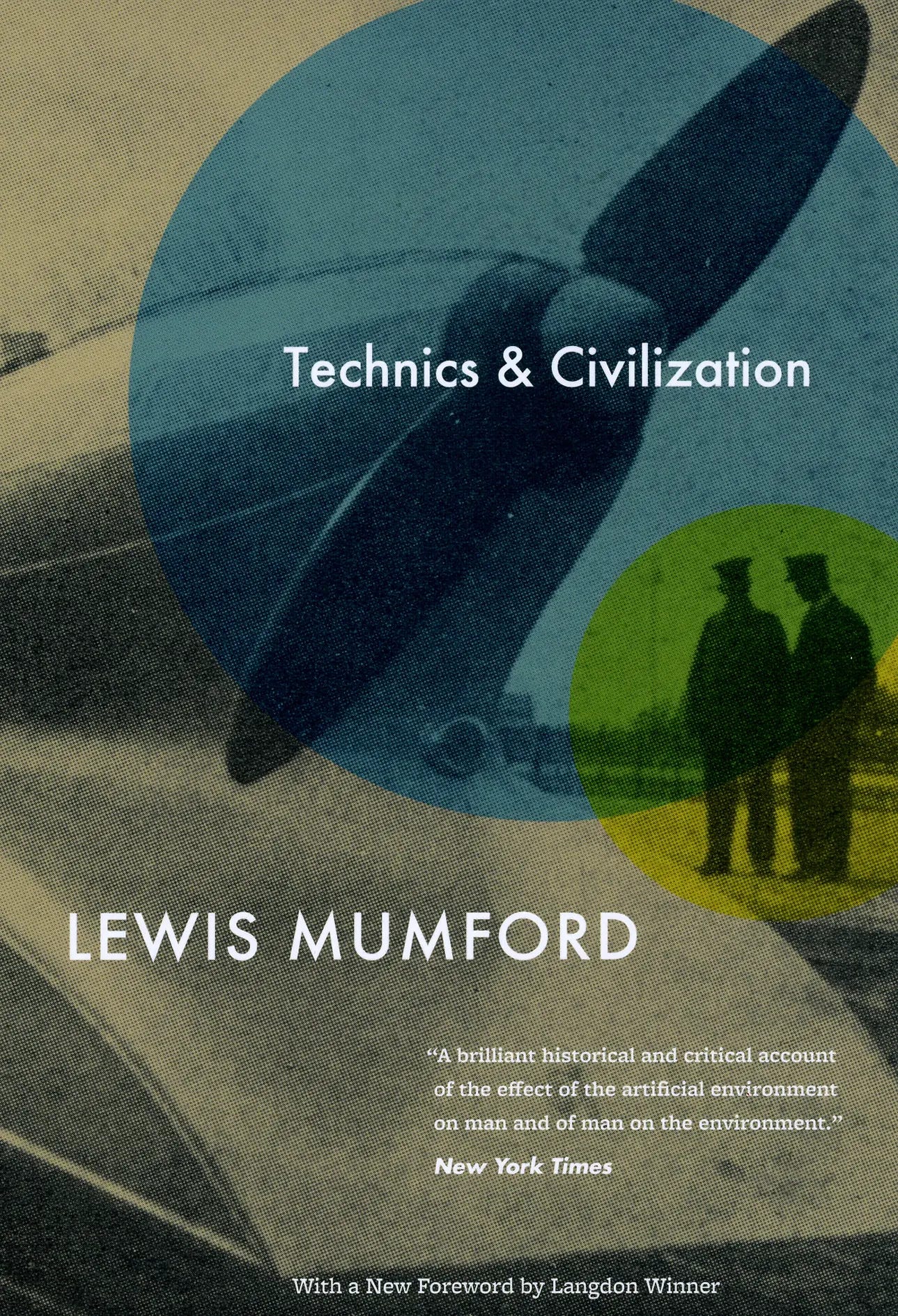
Welcome back to our philosophy of technology book club. This month, we are reading Technics & Civilization by Lewis Mumford, which happens to be available as a PDF online.
Here is the reading schedule:
August 3: Chapter I, ‘Cultural Preparation’
August 10: Chapter III, ‘The Ecotechnic Phase’
August 14: Members-Only Zoom Call, 8 PM Eastern
August 17: Chapter IV, ‘The Paleotechnic Phase’
August 24: Chapter V, ‘The Neotechnic Phase’
August 30: Members-Only Zoom Call, 3 PM Eastern
August 31: Chapter VIII: ‘Orientation’
If you want to support my work, please consider taking out a subscription to Commonplace Philosophy.
At the end of this week’s selection, Lewis Mumford writes:
Clock-making: time-keeping: space-exploration: monastic regularity: bourgeois order: technical devices: protestant inhibition: magical explorations: finally the magistral order, accuracy, and clarity of the physical sciences themselves—all these separate activities, inconsiderable perhaps in themselves, had at last formed a complex social and ideological network, capable of supporting the vast weight of the machine and extending its operations still further.
Mumford is describing the ideological transformation which laid the groundwork for what he calls the machine, which is defined on page 12 as “a shorthand reference to the entire technological complex” that embraces “the knowledge and skills and arts derived from industry or implicated in the new technics.”
Mumford’s goal in the early portions of Technics & Civilization is to explain how the machine came to dominate every aspect of life. As he writes in the prefatory section “Objectives,” in addition to explaining the rise of various machines and industries, “one must explain the culture that was ready to use them and profit by them so extensively.” This, he says, is characteristic of a European civilization—though by now these geographical distinctions may be irrelevant to the discussion. Mumford finished this book in 1931, and nearly a century has passed; likely we will find that places where we want to challenge or extend Mumford in the particulars, though I think he is on to something in general.
Mumford makes a methodological choice in this book, one we should pay attention to. Mumford is arguing that there was an ideological foundation for the rise of the machine, a foundation that made the widespread adoption of certain technologies easier. He is not a technological determinist: he does not think that the development of the machines necessitated new ways of thinking. Instead, there was a period of cultural preparation, where the way we think shifted; this led to the rise of the machine.
The first chapter of his book illustrates how these changes in thinking were already taking place, long before the steam engine and the Industrial Revolution.
First, we have the regularization of time and space.1
Previously, time could be thought of in natural ways, such as the rising and setting of the sun; days were thus irregular; seasons could be measured by actions and events, e.g., lambs ewed or fields harvested. This is not how we think of time now, of course. We think of it as a sequence of units: seconds, minutes, hours, and so on.
Mumford traces this back to the rise of ordered life in monasteries. Benedict of Nursia, for instance, prescribes a number of hours which are to be kept in prayer: matins, lauds, prime, terce, sext, none, vespers, compline; in the seventh century, a papal bull ordered that monastery bells be rung seven times per day. The clock, Mumford says, '“was an almost inevitable product of this life,” and the Benedictines gave us “the regular collective beat and rhythm of the machine.” The clock spread through Europe, in part as a bit of fashionable technology for the well-to-do, but it eventually came to order all of life. Now, we think of our days as being structured by the time on the clock—I eat at 6 am, I work from 9 to 5, I go to bed at 10, etc.
Time took on the character of an enclosed space: it could be divided, it could be filled up, it could even be expanded by the invention of labor-saving instruments.
Technics & Civilization, pg. 17
Space, too, came to be redefined. Mumford argues that in the Middle Ages, space was thought of as a system of symbols and values (pg. 18). The numbering of things took on new significance in the ways it reflected, say, the Gospels or the Trinity. In visual depictions, “size signified importance” rather than literal size—perhaps Mumford would say they had no conception of literal size in the way I have just used it? But space came to eventually be seen as a system of coordinates. This has its advantages, clearly, as it allowed for things like modern map-making and enabled exploration. But this was a real shift: “Both Eden and Heaven were outside the new space; and though they lingered on as the ostensible subjects of painting, the real subjects were Time and Space and Nature and Man” (pg. 21). Like time, space could also be represented mathematically.
Then, we have the rise of capitalism and the move to abstractions (facilitated by thinking in terms of money). As I try to gloss Mumford’s claim: just as time and space began to be understood in terms of abstract representations, so too did production and power. Money comes to stand in for all sorts of things: goods, labor, and the like. (It was also a form of wealth “without assignable limits” (pg. 24).) This led to an acceleration of production and required technological innovation:
Whether machines would have been invented so rapidly and pushed so zealously without the extra incentive of commerical production is extremely doubtful. (Pg. 26)
And this brings with it automation, and automation is characteristic of what Mumford calls machines (distinguished from tools, as the discussion on pages 9-12 shows).
Third, the shift from fable to fact. This could be rendered as ‘disenchantment,’ as we’ve previously discussed in our reading of The Ethics of Authenticity, though this may mislead more than help at this point in the discussion.
Still, we saw a shift away from a symbolic, meaning-imbued view of the world. Mumford writes:
Every culture lives within its dream. That of Christianity was one in which a fabulous heavenly world, filled with gods, saints, devils, demons, angels, archangels, cherubim and seraphims and dominions and powers, shot its fantastically magnified shapes and images across the actual life of earthborn man. (pg. 28)
This wordlview began to lift, and in its place came an appreciation for Nature on its own terms. No longer was the ‘visible world merely a pledge and a symbol of that Eternal World of whoses blisses and damnations it gave such a keen foretaste’—now, the book of Nature could be appreciated in itself. The dissolution of this dream allowed us to look at the world at it actually was; soon, we could think of it mechanistic terms. There were obstacles, however; Mumford calls this the ‘obstacle of Animism’:
So long as every object, animate or inanimate, was looked upon as the dwelling place of a spirit, so long as one expected a tree or a ship to behave like a living creature, it was next to impossible to isolate as a mechanical sequence the special function one sought to serve. (pg. 32)
Here, again, I think we see the theme of abstraction. By abstracting from the particular organism, we could isolate particular functions, and once we had isolated those particular functions, we could build machines that serve those functions. Simply seeking to emulate nature would not be enough—to use one of Mumford’s examples, we did not achieve flight via machine by reproducing the movement of birds’ wings. But before we could do that, Mumford says, we hand to abandon any last vestigages of Animism.
This did not mean that we abandoned the supernatural entirely, however; there is a long and interesting history of European interest in magic, which Mumford takes to be relevant here. This gives me an opportunity to recommend this book again, which is a historical study of the figure of the magus:

Magic was another way of controlling and manipulating the world, which is why Mumford writes that it ‘turned men’s minds to the external world (pg. 40). It also gave birth to a number of real fields, such as chemistry, which was born out of the study of alchemy. At bottom, there is a desire to understand the forces of the world and then to harness those forces for our benefit.
Skipping ahead a bit – so, not following Mumford’s order – we find ourselves now living in a mechanical universe. The Aristotelian (though interpreted through Christianity) worldview was collapsing, and in its place a new idea emerged: ‘a fully articulated philosophy of the universe, on purely mechanical lines’ (pg. 46).
So far, we have been in a highly theoretical realm: time, space, abstraction, even magic. Toward the end of this week’s chapter, we turn to the issue of social arrangement. Before we could mechanize the world to such an extent, we had to mechanize ourselves. Certain virtues – like Robinson Crusoe’s thrift and foresight – began to be held above others. And with Protestantism – Mumford here echoes Weber – we saw the union of finances with a godly life. Production and work become moral imperatives, and this feeds into the abstractions of time, space, and money that we detailed above; our concept of what the good life is changed.
Contrast this with Aristotle’s view of the good life: idleness and contemplation. Aristotle’s good life is laudably useless. But that sort of life was no longer seen as a moral ideal. This shift is sometimes called the Protestant work ethic, though Mumford does not seem to use the term in his book.
We can sum up this new way of life with this passage from Mumford:
Time was real: keep it! Labor was real: exert it! Money was real: save it! Space was real: conquer it! Matter was real: measure it!
And later, at the end of this section, he writes: ‘Mechanics became the new religion, and it gave the world a new Messiah: the machine’ (pg. 45)
New duties emerged, as well, in particular the duty to invent. We see a rise in inventions, many useless, Mumford mentions, because the desire to invent became detached from a search for practical applications. Glossing Mumford: our attention turned from the world around us to the world of machines, and so we sought to bring new ‘life’ (new machines) into this world. When Francis Bacon writes of the New Atlantis, who is honored? Inventors. There are two galleries: one for the inventions and one for the inventors.
This is the cultural groundwork, the foundation upon which the age of the machine would be built. We’ll explore all of this in more detail throughout the month of August as we can continue reading Technics & Civilization.
For space, I’m combining several of Mumford’s sections.
A quote from Mumford's The City in History, chillingly prescient:
"Here, with a heightened consciousness of our past and a clearer insight into decisions made long ago, which often still control us, we shall be able to face the immediate decision that now confronts man and will, one way or another, transform him: namely, whether he shall devote himself to the development of his own deepest humanity, or whether he shall surrender himself to the now almost automatic forces he himself has set in motion and yield place to his dehumanized alter ego, 'Post-historic Man.' That second choice will bring with it a progressive loss of feeling, emotion, creative audacity, and finally consciousness."
I thought of THE SCORE in reading some of Mumford's writing on the quantification obsession: "In time-keeping, in trading, in fighting men counted numbers; and finally only numbers counted." It made me wonder if, in sipping the elixir of datafication and quantification, those concepts performed a sort of *value capture* on those in power and eventually into the broader culture (by force and/or some sort of dazzlement).
Quantification becomes a key value and subsequently guides the way: make number go up, invent more efficient ways to make number go up, etc.