
The Eotechnic Phase
Technics & Civilization, Part II

Welcome back to our philosophy of technology book club. This month, we are reading Technics & Civilization by Lewis Mumford, which happens to be available as a PDF online.
Here is the reading schedule:
August 3: Chapter I, ‘Cultural Preparation’
August 10: Chapter III, ‘The Eotechnic Phase’
August 14: Members-Only Zoom Call, 8 PM Eastern
August 17: Chapter IV, ‘The Paleotechnic Phase’
August 24: Chapter V, ‘The Neotechnic Phase’
August 30: Members-Only Zoom Call, 3 PM Eastern
August 31: Chapter VIII: ‘Orientation’
If you want to support my work, please consider taking out a subscription to Commonplace Philosophy.
When I started to read Mumford, I read the title of this chapter as the ‘The Ecotechnic Phase’—this is wrong, and I was adding an extra ‘c’. The eotechnic phase represents the dawn of the technological complex that Mumford simply calls ‘the machine’ throughout the book. He writes on page 109: ‘I shall call the first period the eotechnic phase: the dawn age of modern technics.
Mumford’s strategy is to divide history into several phases. He inherited this methodology, as well as two of the phases, from Patrick Geddes; Mumford’s contribution is to add the eotechnic phase into this division of history.
We can understand each of the phases as (i) spanning a particular era, (ii) using particular materials, and (iii) producing particular inventions. In the case of the eotechnic phase, it ‘stretches roughly from the year 1000 to 1750,’ though it:
[R]eached its climax, technologically speaking, in the seventeenth century, with the foundation of experimental science, laid on a basis of mathematics, fine manipulation, accurate timing, and exact measurement. (pg. 111)
The eotechnic phase’s characteristic materials are water and wood, though Mumford also spends a considerable amount of time on the importance of glass; this stands in contrast to the paleotechnic phase’s use of coal and iron and the neotechnic phase’s use of alloy and electricity.
Above, I said that a phase produced certain technologies, but there are also the technologies that the phase adopts from earlier eras of history; I believe Mumford takes this to still be characteristic of the particular phase if it is in some way essential to the operation of life and industry in that phase. For instance, while the water wheel and windmill were invented by the Egyptians and the Persians, they are still critical to the eotechnic phase—this is part of the syncretism that Mumford believes is widespread in human invention. Europeans — the primary focus of Mumford’s analysis — adopted and improved on earlier inventions, making them central to their way of life.
What were the most important innovations of the eotechnic phase?
First, the use of horsepower. This represented a move away from ‘human beings as prime movers’ (pg. 112) and began the shift of production processes toward the impersonal. With the development of the iron horseshoe and the modern harness, horses could be used for agriculture and to operate mills for grinding corn or pumping water. This created a cycle where agriculture could be improved, allowing for more horses to be bred and maintained, leading to further increases in productive capacity.
Second, the use of wind and water, particularly for mills. Once again, this meant the liberation of humans from producing energy for machines; now, we could allow water and wind to move these machines, freeing our labor. These machines had the advantage of being cheap to build and easy to maintain, allowing for their widespread use.
Third, the manufacture of boats and ships. Once again, these could rely on power outside of themselves—no longer would you need teams of people using oars to drive a ship, as we invented new forms of sailing. The three-masted design allowed ships to beat against the wind, making long ocean voyages possible (pg. 121). Boats could be used for regional and local transportation, allowing for easier trade; Venice and Amsterdam were the dominant cities, and both featured a network of canals. While canals were again an earlier invention, it was their widespread adoption that allowed for a real change in life.
Fourth, the development of new glass-making techniques. Most critically, clear glass. Clear glass allowed for the production of greenhouses, which could expand the range of time per year when food could be grown by harnessing the power of the sun. Glass also lengthened working days, particularly in northern regions, and freed us from the tyranny of inclement weather (pg. 125). Glass allowed us to cure poor eyesight; some have suggested this expanded learning, as you could continue to study even in old age. Glass also allowed for the development of microscopes and telescopes—suddenly, the world at both macroscopic and microscopic scales was visible to the human eye. Thus, we saw developments in astronomy, bacteriology, and chemistry.
In one of the most interesting sections of this week’s reading, Mumford also argues (very sparsely, unfortunately) that glass allowed for a reconceptualization of the self, as for the first time we could see ourselves clearly; if you had a mirror of polished glass, then you knew what you looked like. Mumford suggests that this is linked to a turn toward introspection. I will admit that I felt these comments were on to something, but they appear to be unsupported in the text. This raises an interesting question: what would it take to establish Mumford’s claim? This is not a rhetorical question; I am genuinely unsure what could possibly constitute evidence or proof. I would be interested to hear what any of you thought because this would be an interesting discussion to link to our discussions of smartphones and the human self.
In §7 of the chapter, Mumford then turns to the primary inventions of the eotechnic phase—most of what we discussed above were, really, refined in the period of eotechnics, but these inventions were brand new. (Mumford’s phrase: ‘The primary inventions brought into being something that had not existed before.’) These are:
Mechanical clocks
Telescopes
Cheap paper
Print
The printing press
The magnetic compass
The scientific method
What do most of these inventions have in common? They produce regularity. The cultural shift that Mumford identifies with eotechnics is one of increased order and regularity. With mechanical clocks, we could all operate on (more or less) the same schedule; this would be important for the factory system that would come to be developed. With the scientific method, we assumed an orderly universe, and this assumption proved fruitful; we made many great leaps in the production of knowledge.
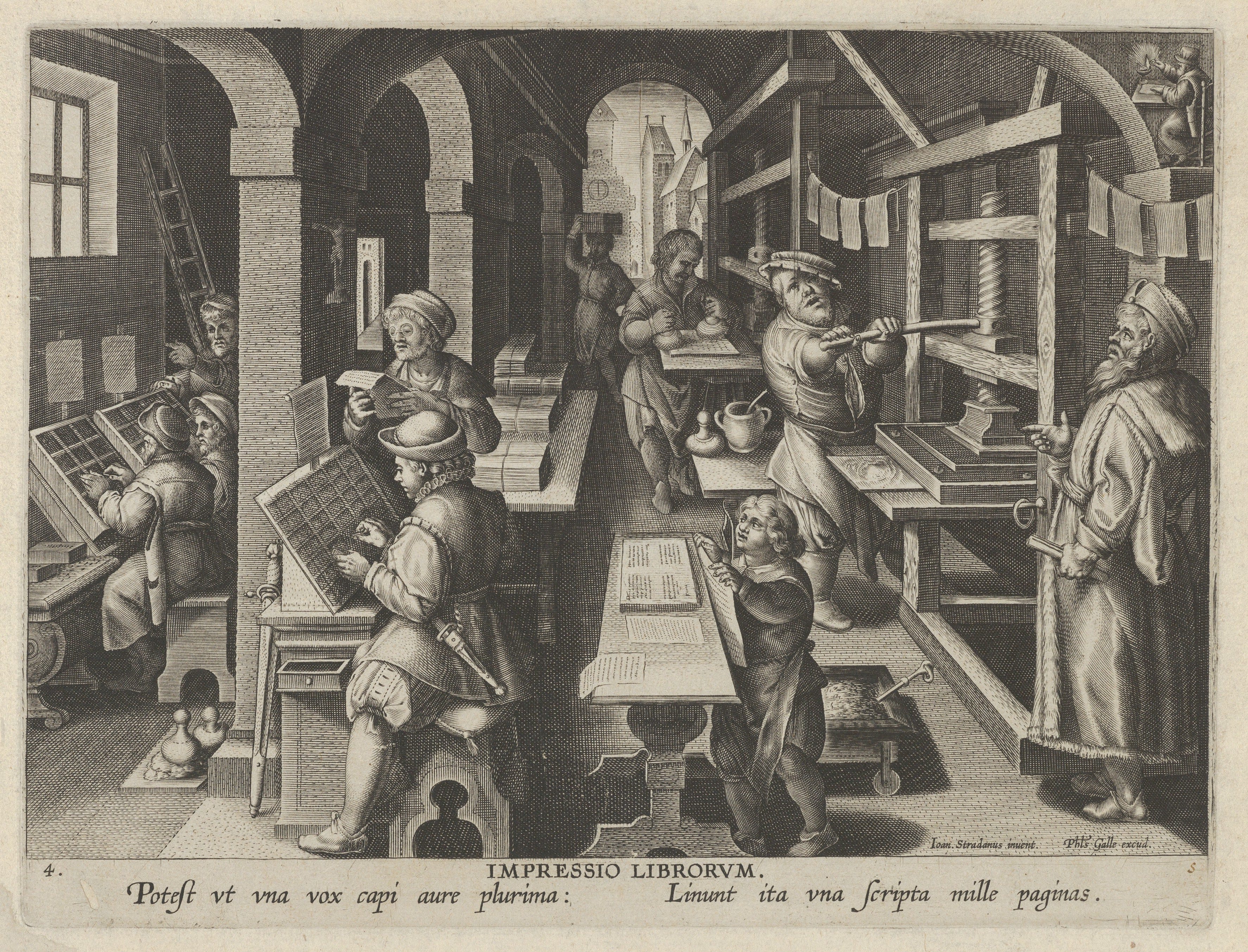
The printing press allowed for the same text to be produced again and again, in quantities previously unimaginable; now, this same text could be distributed across continents. This meant that ‘custom and memory not played second fiddle to the written word: reality meant “established on paper”’ (pg. 136). This section reminded me of something from Aristotle’s work: The Athenian Constitution. Aristotle is credited with the writing of over 150 constitutions, though many scholars believe these to be the work of his students. (It seems implausible that Aristotle could know 150 societies well enough to write their constitutions.) But the provenance of the document isn’t important. What is important is that these constitutions were not founding documents. Rather, they are descriptions of the pre-existing political customs. The written document was secondary to the traditions of the city. Now consider the United States. This country was founded by writing a document. The United States did not exist until the document was drafted and ratified. I think this demonstrates the consequences of the move toward the written word and the printing press; in order for something to be real, it needs to be written down.
Eotechnics also involved the creation of familiar institutions: the university and the factory. Learning and production became more centralized and institutionalized, which naturally trends toward regularity. No longer was production primarily the work of a craftsman in his private workshop; no longer was learning a matter for a scholar in his private study or a monastic in his cell; as we moved into these institutions, our activities became more regular but also more social. But ‘social’ does not mean ‘human,’ necessarily, as in the factory system we saw production become more depersonalized along with the specialization of labor.
I want to highlight one comment from last week’s discussion.
This is from David Feldman, always the skeptic:
I’m finding his thesis plausible, but I’m not seeing a lot of evidence to support it. I read an interesting book recently entitled The Logic of Real Arguments by Alex Fisher. He talks about the Assertability Question “What argument or evidence would justify me asserting the conclusion?” I found myself often wondering about this while reading the first couple of chapters.
Is his view of the evolution of technics and civilization widely accepted by historians of technology? Is it true that clocks are considered the first machines, and that they evolved in monasteries?
I probably could research this myself, but I’m lazy.
The skepticism is warranted. I replied to David, and I’ll include that reply here:
I’ve done some light investigation into this. We’re dealing with a couple of issues, and it is helpful to separate them.
First, the question of historical accuracy. My rough impression is that the field of the history of technology has largely moved on from Mumford’s specific analysis, but that he remains influential for the questions he asked. I found some books (unfortunately all paywalled/very expensive) that try to give more thorough histories of time-keeping; nearly all of them are arguing against Mumford in some way.
Second, the question of whether or not Mumford’s evidence supports his conclusion. If we grant him his evidence for now, I think he holds up fairly well! I understand his conclusion (so far) to be that prior to the Industrial Revolution, we had already moved to more abstract/rationalistic conceptions of key concepts, and that this facilitated the rise of ‘technological complex’, as we were already mentally thinking in machine-friendly terms. But then we have to go back and look at all of the history to see if this argument is found.
I found this critical review, which I’d like to read but can’t access. I’m going to ask around to see if I can get a PDF from someone with university library access: https://muse.jhu.edu/pub/1/article/33894/pdf
I’ve since been sent a PDF of that article—the review is highly critical. I’m going to write something about it separately, as it would bloat this section.
David is exactly correct to be asking these sorts of questions. The division of history into neat phases seems to have been totally abandoned by modern historians; if someone works in history and can explain this methodological shift, please do. Mumford is also dealing with a huge amount of history, and it is difficult to assess — partly due to a paucity of sourcing —where he gets it right and where he gets it wrong. He is also fond of making this sort of move (paraphrasing): ‘Yes, this doesn’t fit my timeline, but…’ Once you notice it, you’ll see it everywhere.
This has made me skeptical about the divisions of history and about Mumford’s particular factual claims. Yet, I’m still enjoying the book, as I think his description of the effects of some of these technologies may be correct.
I just joined this group and have no experience reading philosophy.
It occurs to me the evidence for Mumford's "mirror" thesis could be found in literary and art history. How people wrote about or portrayed themselves might be correlated to the development and spread of mirrors. For example, Shakespeare's sonnet 3 uses three images of glass (mirrors and windows) in a poem about how we're going to die and only live through our children (more or less). Is this evidence of introspection? I'm not sure. People have been thinking about dying for a long time.
I also googled around and found a couple of books that could shed light on this: "The Mutable Glass" by Herbert Grabes and "The Self Portrait: A Cultural History" by James Hall.
The description of Grabes' book reads in part:
"This 1982 book was the first major and comprehensive survey of mirror-imagery to be found in medieval book-titles and English literature from the thirteenth to the end of the seventeenth century... Professor Grabes not only traces the shifting historical usages of the mirror (as the metaphor's 'vehicle') but also studies the metaphor's structural function in individual works... by investigating the function of a metaphor central to literature over a long period of time, he reveals the interplay between cultural history, the changing attitude towards life and the world, and literary imagination."
The introduction to "The Self Portrait" says that "Conventional wisdom has it that... good quality crystal glass mirrors... [led to] the irresistible rise of self-portraiture." But it later discounts that idea, writing "[d]evelopments in mirror technology are largely irrelevant, and this 'mirror myth' has clouded discussions of [self-portraits]."
Anyway, that's all I got: some vague ideas and possible sources for further study, if you're inclined. Don't expect any better!
Re: evidence for increased introspection / focus on the self: I recently re-read Anna Kornbluh's book IMMEDIACY, and there she tracks the popularity of first-person novels as evidence for a related concern. As a parallel move I'd offer tracking the proliferation of the first-person (or the sheer frequency of the pronoun "I") in published works (poems especially) alongside Mumford's glance at portraiture and a brief mention of romantic poetry; there's collectable data there that could help prove the point a little bit, I think.
Second, you highlight the effect the greenhouse had on a grower's relationship to the seasons -- I've been struck by how profoundly technology and machinery has altered our relationship to time. First the clock created a new definition of time itself, essentially, but from there we as a species have had so many touch-points with time made less organic and more machine-like: the greenhouse, the mine (forgive me, I'm nearly done with next week's chapter, so, ya know, spoilers), even "the rhythm of movement disappeared; within the factory the quick staccato of the machine displaced the organic rhythms, measured to song, that characterized the old workshop."
I'm not sure if he'll dive into it, but I'd be curious about how all of this invention directly changed the sleep habits of different cultures.