
The internet is designed to make you misinformed, angry, and poor
Engagement, clustering, and manufactured desire

This post is too long for email. If you want to read the full piece, you’ll need to read it on Substack.
Early internet users, many of whom were also early internet activists, believed this technology would be as revolutionary as the printing press or the steam engine, both of which radically transformed how human beings related to each other. While it took some time for printed books to catch on (Gutenberg went bankrupt, but eventually others figured out the business model), and at first steam power was primarily used for manufacturing, both of these technologies allowed us to take a great leap forward—in particular, they allowed us to connect with other human beings across vast distances. Once you have a market for books, it becomes possible to read the thoughts of others, even those who live on other continents; once you have railroads, you can travel more quickly from city to city, allowing you to have conversations that would previously have required slow correspondence. The internet was to be no different.
Imagine how it must have felt—being introduced to this technology that allowed you to speak seemingly instantaneously with someone on the other side of the world. I’m too young to properly appreciate it, I think; the internet was widely distributed in my childhood, and I spent a lot of time on AOL talking to friends, cousins down in Florida, and even strangers. For someone who grew up without the internet, it must have felt like a paradigm shift.
Paradigm shifts tend to produce two sorts of responses: doomerism and giddy optimism. (We can see this now with discussions of AI—who among us just shrugs?) In the case of the early internet, we have documents that capture some of the latter. Writing his ‘A Declaration of the Rights of Cyberspace,’ John Perry Barlow said this to the would-be regulators of this new technology:
You claim there are problems among us that you need to solve. You use this claim as an excuse to invade our precincts. Many of these problems don’t exist. Where there are real conflicts, where there are wrongs, we will identify them and address them by our means. We are forming our own Social Contract. This governance will arise according to the conditions of our world, not yours. Our world is different….We are creating a world that all may enter without privilege or prejudice accorded by race, economic power, military force, or station of birth….We are creating a world where anyone, anywhere may express his or her beliefs, no matter how singular, without fear of being coerced into silence or conformity.
For Barlow, we were creating a world without privilege or prejudice, where free expression could win out over physical coercion. The constraints of the old world were no more—we were building something new, something better.
This did not come to be. Pessimism about the internet is widespread, even among the power users who spend all their time online. And here I think that the pessimists are on to something.
In a nutshell: the internet is designed to make you misinformed, angry, and poor.
But this, I want to argue in this piece, was not inevitable; the optimists like Barlow weren’t predicting an impossibility. Rather, the modern internet’s problems are specifically the result of design choices. This should be cause for some hope. If the internet’s problems are the product of our choices, then this means that we can make different, hopefully better, choices in the future.
Engagement
Unless you make specific choices on how you curate your online experience, most of the information you are confronted by online is the result of an algorithmic process. These systems are highly complex – I won’t pretend to understand them in any depth – but we know that these algorithms are not neutral content recommendation systems; they were created with a purpose. Very roughly, the purpose of those algorithms is to keep you online for as long as possible.
It is easy to see why. Since most platforms make money from ads, and they can only cram so many ads in a single video, article, or feed, the best way to show more ads to more customers is to create an experience where you will want to spend more and more of your time on the platform. They do not only want you to spend time on the platform, however; they want you to be highly engaged. Engagement encompasses a wide variety of behaviors: views, likes, comments, shares, etc.
In order to promote engagement, you need to be shown content that interests you; that’s the bare minimum. I opened a YouTube page in an incognito browser while using a VPN, and here is what I saw.
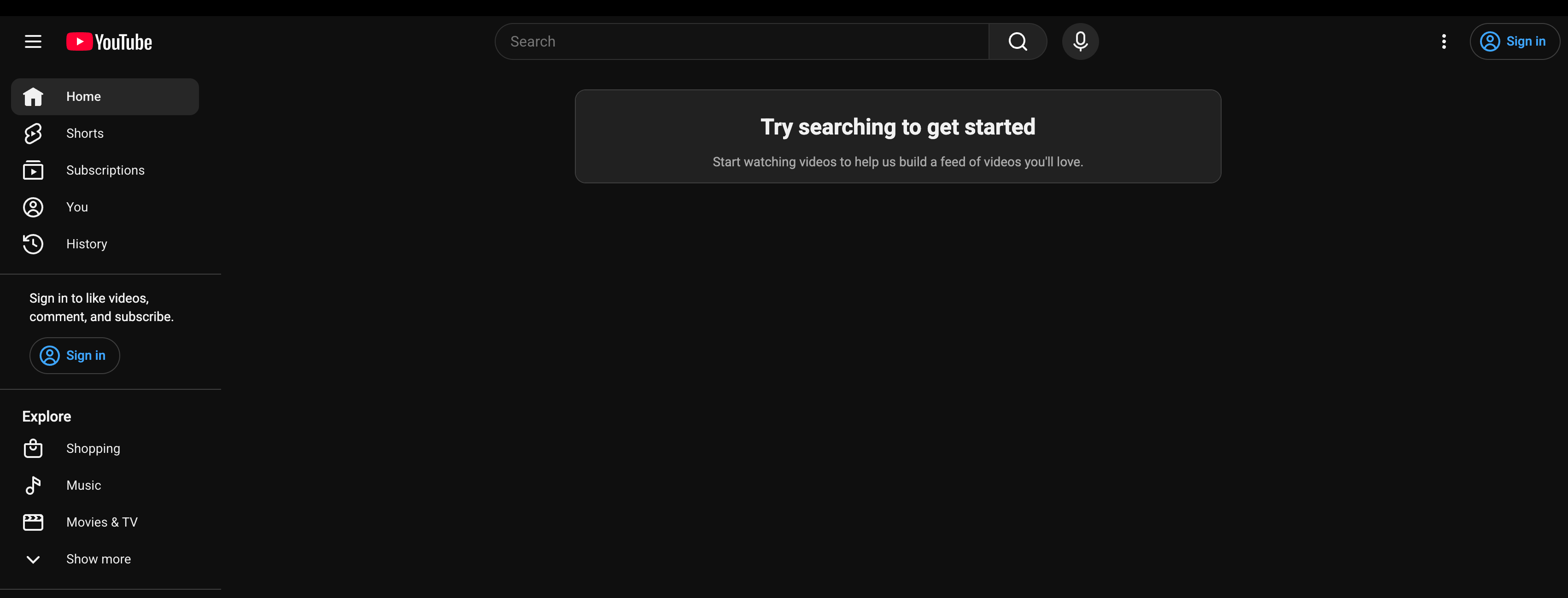
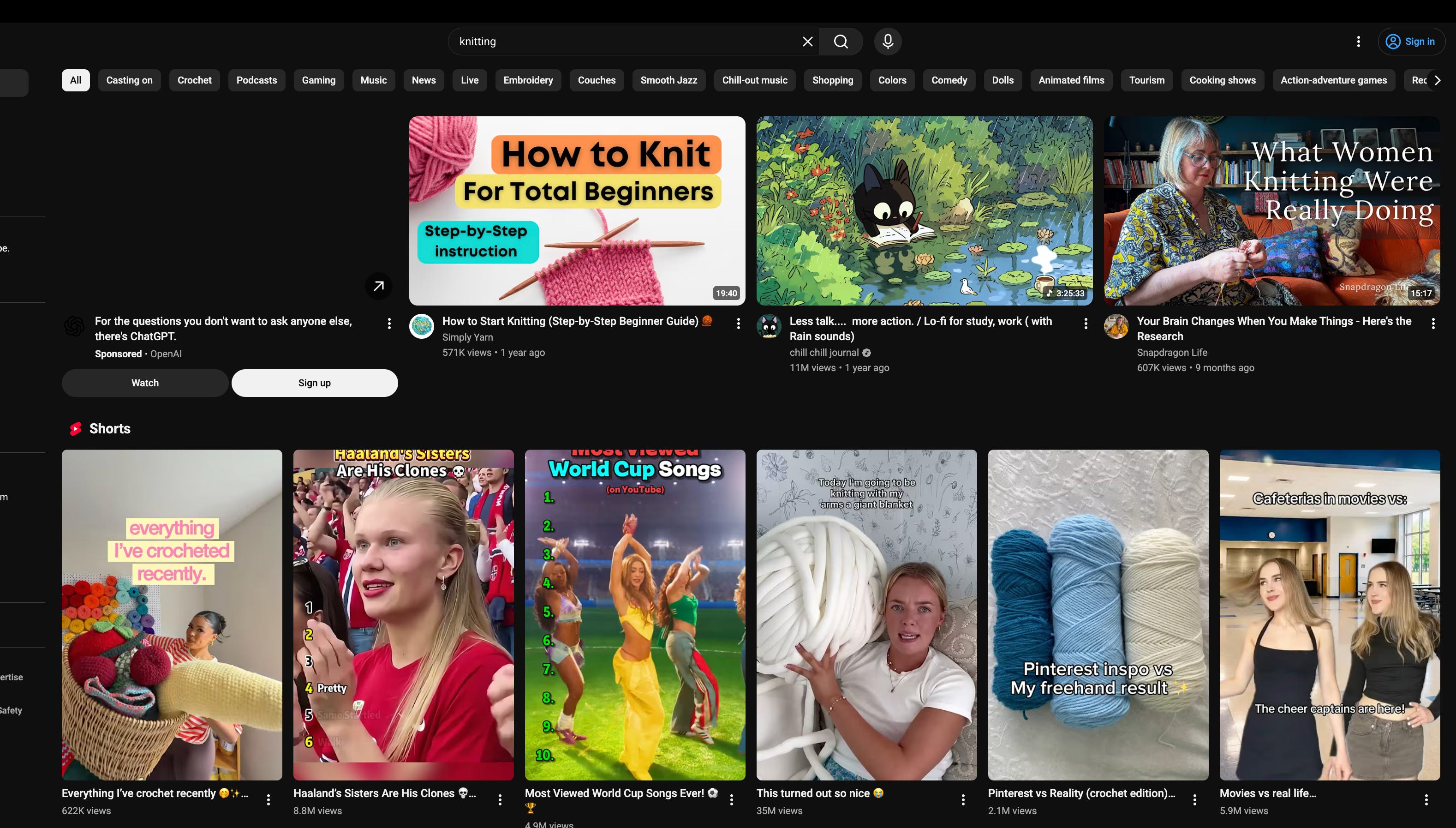
The platform knows nothing about me, my preferences, my behavior, and so it cannot show me anything. But let’s say I decide to make a single search for ‘knitting,’ a hobby I have no knowledge about. After searching, I watched (in the background, with the sound off, but YouTube won’t know that) part of a video guide to knitting for beginners.
Now YouTube can make some suggestions, and you can discern what the algorithm is thinking here. (Forgive the anthropomorphism.) I like knitting; I should be shown knitting videos. But it isn’t only showing me guides about knitting—it’s feeding me content related to knitting that isn’t quite what I originally searched for.
And for good measure, we have some cozy lofi music and a YouTube short about Erling Haaland’s sisters.
But if I scroll down a little, the recommendations begin to change. We’re now in the realm of beauty tips, weight loss, some high school romance shorts, and a video about (seemingly) the evils of gender neutral parenting.
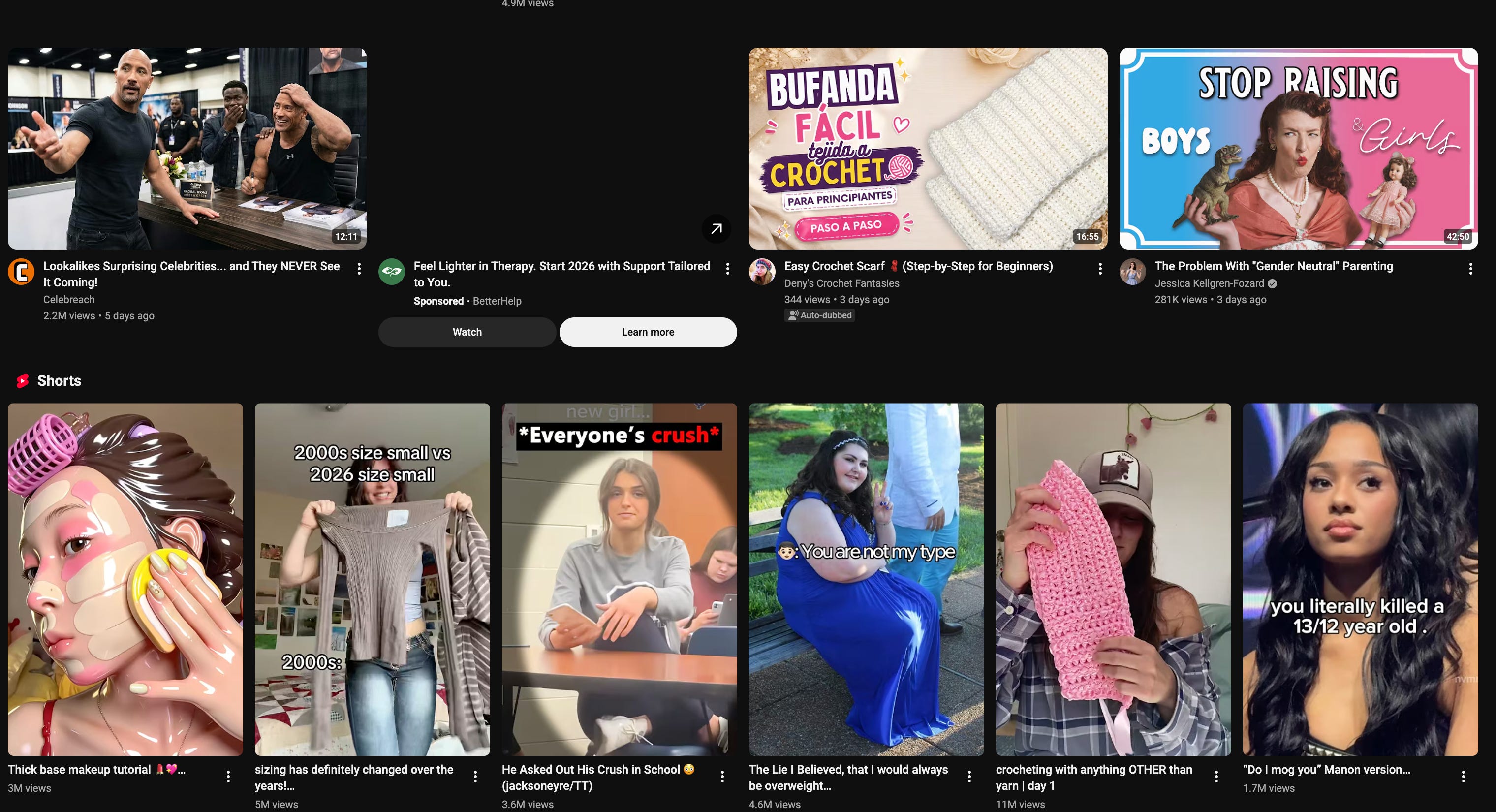
It turns out I was wrong! I clicked on the gender neutral parenting video, and it is a video that argues against gendered and gender-neutral parenting—so, a fairly progressive view on child-raising. Perhaps the algorithm thinks that women (I think the algorithm assumes I’m a woman by now) want to watch parenting content and generally trend liberal/progressive.
In their book You and Your Profile, Hans-Georg Moeller and Paul J. D’Ambrosio argue that we have entered into a new paradigm of identity formation, which they call profilicity. They write: ‘we form identity through curating profiles. Profiles are images of ourselves presented for second-order observation. By looking at them, others can see how we like to be seen as being seen.’ Moeller & D’Ambrosio see this as potentially liberatory, with profilicity allowing for a fluidity of identity that previous paradigms (like sincerity and authenticity) could not. Identity is something that is constantly being constructed; we can now cast off old identities, just as we change usernames or switch accounts. A reader of You and Your Profile could be forgiven for thinking that this is an unequivocal good, as the authors spend considerable time critiquing the concept of authenticity and other standard objections to internet-based identity formation.
Yet, there is something missing in their analysis, namely the fact that you are not the only one building your profile. In an algorithmic ecosystem – like Instagram, Substack, Facebook, etc. – the algorithm is constructing a profile of you as well.
You are being profiled.
In my toy example above, the YouTube algorithm was building a profile for me. It believes I am a woman, speak English, and have (in the eyes of the algorithm) standard female interests, including weight loss and romance. Before I post anything – remember, I never liked or commented in that example – my profile was being constructed, and this was reflected in the content that I was served.
This is foundational to engagement-optimizing platforms. In order to succeed, these platforms must build these user profiles, as this allows them to successfully recommend more relevant content to their users.
This is the design decision that, I will argue, underlies all the major problems we have on the modern internet.
Clustering
Because we are all being profiled by these platforms, we naturally cluster. You might think that this is a good thing—this is how the platforms give us what we want. But there is a risk here.
C. Thi Nguyen puts forward a distinction between two types of clusters: epistemic bubbles and echo chambers.
Epistemic bubbles, he writes, are social epistemic structures ‘in which some relevant voices have been excluded through omission.’ Suppose you’re sitting around with your friends and arguing about the best tacos in Austin. Alejandro might say that it’s Tacodeli; Betsy thinks it’s Torchy’s; Callum insists that it’s Las Trancas. You and your friends are likely in an epistemic bubble, as some relevant voices – people who might know better – aren’t there to chime in. But this is a low-stakes example, and there does not seem to be much harm in these sorts of bubbles—the only downside here is that no one is there to argue that the best tacos in the city are found at Veracruz All Natural. And while it is sad that you won’t get to eat the best tacos in Austin, this is a relatively minor harm.
There was nothing pernicious about the omission here. You are arguing with your friends; it would be odd to object ‘Well, have we considered all the relevant voices?’ in that sort of social setting, as the stakes are relatively low and the costs of finding all the relevant voices are relatively high.
Things get slightly more complicated when we raise the stakes. If you’re arguing about politics with your friends, it is likely that you are not being exposed to a diverse range of viewpoints and arguments—just like the internet, we tend to cluster by interests and politics in real life. When you omit relevant voices, then you’re likely to have an incomplete account of whatever matter is under discussion. But again, it would be unreasonable to say that in every conversation you had to find and engage with all the relevant voices; that’s simply infeasible, and while ‘ought’ does not imply ‘easy to do,’ I do think feasibility objections are relevant when we’re talking about our epistemic duties. So long as you try to be generally responsible, perhaps by looking into the matter more deeply in private or having many different political conversations, the fact that you are in an epistemic bubble will not be a problem, and in some cases it is desirable.
It’s helpful to remember that in real life, we occupy many different bubbles. Let’s say you’re a devout Muslim and also an academic philosopher. When you’re at the local Islamic center, you (probably) aren’t going to be arguing about the ontological argument for God, as the existence of God is taken for granted in those contexts. But in a philosophy department, it’s almost certainly a contested issue—you’ll thus be exposed to different arguments and perspectives depending upon which bubble you’re currently in. What is up for debate and what is taken for granted is largely determined by the shared goals and values of the group; sometimes, it would be detrimental to that group’s projects to actively seek out dissenting voices.
