
The Modern Malaise
The Ethics of Authenticity, Part I

Welcome back to our philosophy of technology book club. This month’s book is The Ethics of Authenticity by Charles Taylor. Here is the reading schedule
June 8: Chapter I-III (approx. 30 pages)
June 15: Chapters IV-VI (approx. 40 pages)
June 19: Members-Only Zoom Call, 8 PM Eastern
June 22: Chapters VII-VIII (approx. 22 pages)
June 29: Chapters IX-X (approx. 30 pages)
July 5: Members-Only Zoom Call, 3 PM Eastern
I pushed the final Zoom call to July 5, as I’ll be in New York the last week of June for a workshop with the Marc Sanders Foundation.
We also have a supplemental reading for this month: Wendell Berry’s ‘Why I Am Not Going to Buy a Computer.’ I’ll send out a post about that essay the week of June 22.
One further note: you can listen to Taylor delivering these lectures for free on YouTube. Thanks to a reader for pointing out that a recording was available. (Note: there may be some differences between the lecture and the text.)
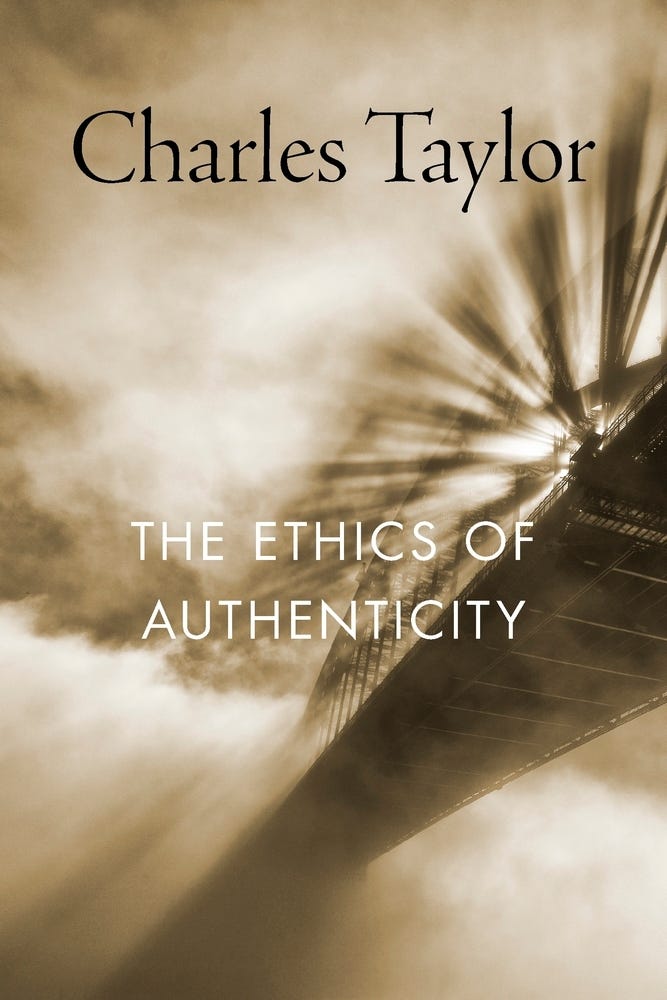
Charles Taylor opens The Ethics of Authenticity by identifying three sources of our modern malaises. These malaises, he writes, are ‘features of our contemporary culture and society that people experience as a loss or a decline, even as civilization “develops.”’ Taylor delivered the lectures that make up The Ethics of Authenticity in 1991, and his book was published in the same year, and yet thirty years later, readers coming to this text immediately recognize the point he is making. Nostalgia is rampant, and nostalgia is fueled by a sense that we have lost something that we can perhaps never recover — though in its more extreme and troubling forms, nostalgia is the longing for a past that never really existed. Even the way contemporary culture endlessly recycles hits and trends from the recent past – the Eighties were the thing when I was in high school, the Nineties had their moment, now I see young people longing for the turn of the century – reflects, I think, the widespread sense that we have lost something, along with the widespread desire to reclaim it. But Taylor is not a reactionary; he is not longing for a simple return to the past; he’s too sophisticated for that. What Taylor wants to do in these lectures is take the widespread malaises seriously, investigate their roots, and see if there is something that can be done about it.
You may have wondered while reading this why it was chosen for a year-long book club on the philosophy of technology. I hope to draw out certain connections between The Ethics of Authenticity and the texts that we have read so far, as Taylor provides a more robust philosophical analysis of the moral dimensions of our technological age than anyone we have read so far.
The three malaises Taylor identifies in Chapter I are:
1. Individualism.
2. The disenchantment of the world and the rise of instrumental reason.
3. The restriction of choice brought about by the institutions of an industrial-technological society.
First, individualism. Individualism can be understood by contrasting it with what came before. Here, some terminology from Moeller & D’Ambrosio (adapted from Lionel Trilling) is useful: sincerity. We learned that to be sincere meant that one lived up to his or her social role; by living out this role, one could derive a sense of significance or meaning. (I understand ‘significance’ and ‘meaning’ to be synonyms, roughly the same as a purpose.) These roles were not simply assigned — they were often justified by an appeal to a greater order, sometimes backed by metaphysical claims (e.g. ‘the great chain of Being.’) You could imagine yourself as a part of a larger organism, perhaps even the whole cosmos, the workings of which you might be ignorant, and as part of this larger organism your individual actions, however apparently insignificant, could be imbued with meaning. You were contributing to something larger than yourself. There was a purpose, believed in if not fully realized. A craftsperson, a parent, a teacher, a knight, a business executive, a day laborer—all of these were somehow involved in this larger project. Even the non-human world could be said to be involved in this. But sincerity was eventually replaced by authenticity, about which we will have much to say.
Individualism brings with it many benefits: ‘Modern freedom was won by breaking loose from older moral horizons…Modern freedom came about through the discrediting of such orders.’ This freedom is surely worth celebrating – this is something I appreciate about Taylor, his refusal to simply criticize or simply discredit some notion, but to properly consider it – but with this freedom came a loss, too: ‘People no longer have a sense of a higher purpose, of something worth dying for.’ This has been recognized by Kierkegaard, by the Romantics (perhaps, speaking very generally), and by Nietzsche. As we become more individualistic, we also narrow our vision. ‘The dark side of individualism is a centering of the self, which both flattens and narrows our lives, makes them poorer in meaning, and less concerned with others or society.’
Second, the disenchantment of the world and the rise of instrumental reason. Taylor defines instrumental reason: ‘the kind of rationality we draw on when we calculate the most economical application of means to a given end. Maximum efficiency, the best cost-output ratio, is its measure of success.’ I do not think that Taylor is criticizing instrumental reason as such, but rather the way that instrumental reason has come to dominate other forms of rationality. To link this directly with technology, consider Heidegger’s comments from ‘The Question Concerning Technology,’ where he gives us the concept of enframing. As nature becomes enframed, it becomes something to be used. Writing about the construction of a power plant on the Rhine, Heidegger wrote: ‘Even the Rhine itself appears to be something at our command…What the river is now, namely, a water-power supplier, derives from the essence of the power plant.’ Given the presence of these technologies, we now view the world as something to be used. No, that is not strong enough: we come to only view the world as something to be used. Thus, the link between disenchantment and the rise of instrumental reason.
Taylor goes on to say:
The primacy of instrumental reason is also evident in the prestige and aura that surround technology, and makes us believe that we should seek technological solutions even when something different is called for…The dominant place of technology is also thought to have contributed to the narrowing and flattening of our lives…People have spoken of a loss of resonance, depth, or richness in our human surroundings.
Third, the restriction of choice brought about by the institutions of an industrial-technological society. These malaises seem to build on each other. The individualist, perhaps, must person his or her own self-interest, with no thought to a cosmic order or a large collective; this leads to the primacy of instrumental reason, as he or she is looking for some way to satisfy the individual’s desire; but if we value instrumental reason so highly, we naturally tend to defer to experts who can more fully understand the situation; society itself becomes a technological problem to be solved. As a consequence, ‘An individual life is also hard to sustain against the grain.’ The picture Taylor is painting is quite bleak here. What we are left with is an individualist culture where no one, truly, can be an individual.
Taylor’s focus in The Ethics of Authenticity is primarily the first source of our malaise, individualism. I believe this is a sound choice given the length of the text and given the structure of the problem. To understand (2) and (3), we must understand (1) in its complexities.
But where is Taylor going? He tells us on page 11, right at the end of Chapter I:
I will claim that the right path to take is neither that recommended by straight boosters nor that favoured by outright knockers. Nor will a simple trade-off between the advantages and costs of, say, individualism, technology, and bureaucratic management provide the answer…I want to claim that both boosters and knockers are right, bu in a way that can’t be done justice to by a simple trade-off between advantages and costs. There is in fact both much that is admirable and much that is debased and frightening in all the developments I have been describing, but to understand the relation between the two is to see that the issue is not how much of a price in consequences you have to pay for the positive fruits, but rather how to steer these developments towards their greatest promise and avoid the slide into debased forms.
We’ll see this in the following chapters.

Taylor takes a seemingly odd pivot in Chapter II, beginning with a discussion of Allen Bloom’s The Closing of the American Mind and, in particular, Bloom’s observation that modern students have adopted ‘a rather facile relativism.’ As Taylor describes it, this relativism holds that ‘everybody has his or her own “values,” and about these it is impossible to argue.’ What is odd about this position is that it was held not as an epistemological position (‘we can never settle ethical debates’), but rather as a moral position (‘we ought to respect the values of others, to the point where we should not argue about them’).
In other words, the relativism was itself an offshort of a form of individualism, whose principle is something like this: everyone has a right to develop their own form of life, grounded in their own sense of what is really important or of value.
This is not the relativism that I used to consider when I was teaching ethics to undergraduates. It was typical for introductory ethics courses to start with debates about cultural relativism; we often assigned James Rachels’ short article on the subject. The assumption was that students were predisposed to a kind of relativism that said that there was no objectivity to ethics, except the local objectivity within a particular culture. There were many ethical systems, and the ‘right’ ethical system was the one the culture endorsed. We would then spend a few hours going through the problems with this view — a view, I would add, that seems to have no defenders in professional philosophy. (If you know of an exception, please let me know.) Which, if you think about it, is odd: an academic lecture on ethics beginning with a prolonged discussion of a view that no one seemed to seriously espouse. The only justification I can think of was that it was a kind of ground-clearing exercise, allowing us to get to the real issues. The assumption was that moral relativism was the default position of the American undergraduate. But Taylor’s target relativism is not cultural; it is individualistic. And there is something to this—he notes that it is grounded in a principle of mutual respect, and there is something like this idea in the history of liberalism. Taylor dubs this ‘the individualism of self-fulfillment.’ But another word for this would authenticity. Authenticity has become a moral ideal, which is ‘a picture of what a better or higher mode of life would be, where “better” and “higher” are defined not in terms of what we happen to desire or need, but offer a standard of what we ought to desire.’
Authenticity has many critics—Taylor mentions Lasch, Bell, and Lipovetsky. Taylor does not want to join these critics, however, because he notices the ‘moral force of the ideal of authenticity,’ which has sunk ‘to the level of an axiom, something one doesn’t challenge but also never expounds.’ Thus, Taylor dubs this chapter The Inarticulate Debate, and he later writes:
Critics of contemporary culture tend to disparage [authenticity] as an ideal, even to confound it with a non-moral desire to do what one wants without interference. The defenders of this culture are pushed into inarticulacy about it by their own outlook.
The defenders of authenticity, he is saying, cannot defend the ideal of authenticity because they use to ground a subjectivist system of ethics; if one is a subjectivist, you can’t go around trying to convince people about what’s right, because they already know what’s right for them; that’s the whole point of subjectivism. Taylor is stepping in to defend authenticity, which is:
An ideal that has degraded but that is very much worthwhile in itself, and indeed, I would like to say, unrepudiable by moderns…What we need is a work of retrieval, through which this ideal can help us restore our practice.
In other words, we need to retrieve the (authentic?) idea of authenticity. That is the project of the book.
But we don’t get much of it this week, as Chapter III is only a few pages. We’ll finish our discussion this week with Taylor’s exploration of the sources of authenticity.
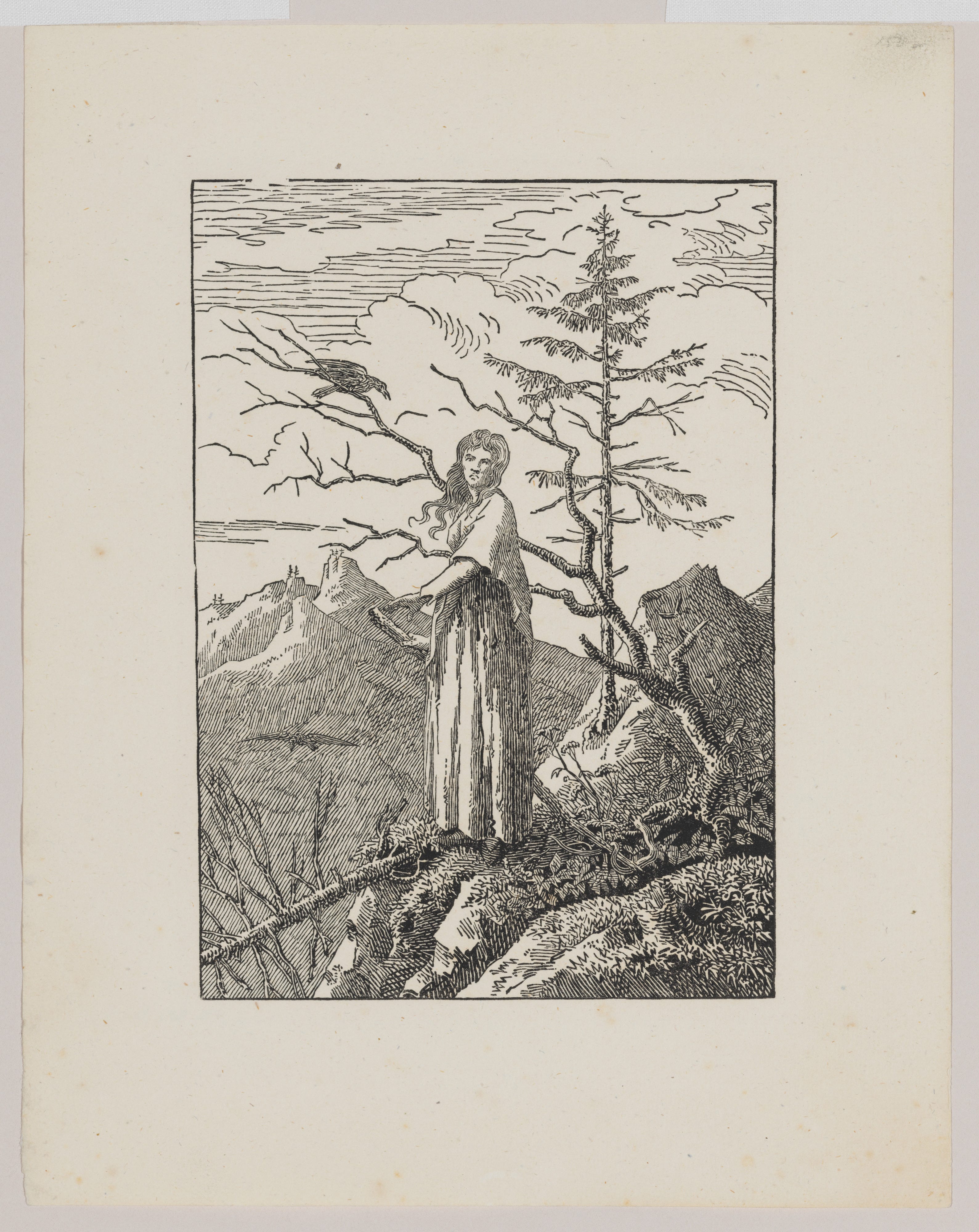
While our understanding of authenticity has many precursors (Taylor names Descartes and Locke as individualist forerunners), this particular idea seems to originate from the Romantic period — which I was considering as a topic for next year’s book club, in fact. (If that sounds interesting or awful, please let me know.)1
It begins with the idea that ‘human beings are endowed with a moral sense, an intuitive feeling for what is right and wrong…Morality has, in a sense, a voice within.’2 But this idea shifts away from the idea that morality speaks to us through the conscience – I think this is a good approximation of what Taylor is saying here – and instead becomes an ideal where we need to be attuned to this inner voice. If we lack this attunement, we are not ‘true and full human beings.’ This marks a shift away from something external to us (God is the easy example) to something internal to us. This shift takes time. A rough chronology, adapted from Taylor: from Augustine’s idea that ‘the road to God [passes] through our own reflexive self-awareness of ourselves’ to Rousseau’s idea that ‘morality [is the issue of] following a voice of nature within us’ to the Romantic ideal found in Herder. We are given what I think will be an important term for the rest of our discussion: self-determining freedom. Here is Taylor’s description:
[Self-determining freedom] is the idea that I am free when I decide for myself what concerns me, rather than being shaped by external influences. It is a standard of freedom that obviously goes beyond what has been called negative liberty, where I am free to do what I want without interference by others because is compatible with my being shaped and influenced by society and its laws of conformity. Self-determining freedom demands that I break the hold of all such external impositions and decide for myself alone.
Self-determining freedom, Taylor says, developed in tandem with authenticity. Here we see Herder, who held that ‘each of us has an original way of being human.’ This becomes a moral ideal:
I am called upon to live my life in this way, and not in imitation of anyone else’s. But this gives a new importance to being true to myself. If I am not, I miss the point of my life, I miss what being human is for me.
I have emphasized ‘to be true to myself’ in this passage. With Herder, we find a conception of the individual as radically unique, and with that conception of the individual, we find a new moral command: be true to oneself. I’ll end with Taylor’s final words:
Being true to myself means being true to my own originality, and that is something only I can articulate and discover. In articulating it, I am also defining myself. I am realizing a potentiality that is properly my own. This is the background understanding to the modern ideal of authenticity, and to the goals of self-fulfillment or self-realiziation in which it is usually couched. This is the background that gives moral force to the culture of authenticity, including its most degraded, absurd, or trivialized forms. It is what gives sense to the idea of “doing your own thing” or “finding your own fulfillment.”
The idea would be to read some Herder, Holderlin, Goethe, even a bit of Hegel, and eventually end with some Nietzsche. I haven’t mapped it out in much detail.
Though in a footnote to this passage, Taylor mentions Frances Hutchinson as originating this idea, which he explores more fully in Chapter 15 of Sources of the Self.
Since Taylor didn’t leave us a large amount to discuss yet I’ll submit what I think would be good Romantics syllabus:
Plato, Timaeus
Spinoza, Ethics
Kant, Prolegomena
Schiller, Aesthetic Education of Man
Fichte, Introductions to the Wissenschafteslehre
Novalis, Notes for a Romantic Encyclopedia or Fichte Studien
Holderlin, one of the collection of his essays and letters
Schelling, he has some shorter writings available online that give a good view of his early Naturphilosophie and Identity system periods and then I might pick something from late Schelling like Investigations on the Possibility of Human Freedom for a complete book of his.
I would definitely intersperse into this the Goethe, Herder etc you already mentioned.
Timaeus and anything major by Spinoza are somewhat indispensable source texts for Romanticism, along with the Critique of Pure Reason but I wouldn’t be mean enough to suggest that for a book club book. The major movement of German Romanticism is to feel a deep need to bring Kant as expounded by Fichte into harmony with Platonism and Spinozism, so it helps to have a little background. They didn’t feel that you could naively escape Kantian critique but they did feel that Kant gave an unsatisfactory picture of the world.
If you had to pick only Hegel or Schelling, I would pick Schelling. Hegel breaks with Romanticism and ends up forming its raw materials to his own ends but Schelling for much of his long career is giving elaboration and systematization to the Romantic strain of Absolute Idealism which was first explored by Holderlin, Schlegel, and Novalis. Schelling is also deeply under appreciated in the Anglophone world so you would be righting a wrong.
I can already see many themes in the first 3 chapters that have been present in our past readings, making this selection a great fit for this book club.
Taylor's talk about life being 'flattened' is reminiscent of Han's ideas of non-things 'de-reifying' the world. Just as Han described us having less of a relationship with the physical world, Taylor is describing how, turning inward, we are experiencing less of the world and community that used to exist.
Additionally, Taylor mentioned how institutions are limiting our choices, and this reminded me strongly of Nguyen's work that we just read. Metrics that institutions are gathering are used to make choices for us, and we don't have a lot of choice in those decisions.
I was struck by how relevant these ideas are to today's current culture, especially in the US. Now more than ever, it seems important to engage with a community and not just do things for yourself. Corporations and institutions have tried to separate us, and want us to stay that way, because they know there is strength & power in numbers & community.