
The Paleotechnic Phase
Technics & Civilization, Part III

Welcome back to our philosophy of technology book club. This month, we are reading Technics & Civilization by Lewis Mumford, which happens to be available as a PDF online.
Here is the reading schedule:
August 3: Chapter I, ‘Cultural Preparation’
August 10: Chapter III, ‘The Eotechnic Phase’
August 14: Members-Only Zoom Call, 8 PM Eastern (Recording available)
August 17: Chapter IV, ‘The Paleotechnic Phase’
August 24: Chapter V, ‘The Neotechnic Phase’
August 30: Members-Only Zoom Call, 3 PM Eastern
August 31: Chapter VIII: ‘Orientation’
If you want to support my work, please consider taking out a subscription to Commonplace Philosophy.
You might have thought that this chapter was going to be triumphant. Having now reached the Industrial Revolution, and having seen Mumford’s celebratory description of the eotechnic phase, it would be understandable if you assumed that this would follow the same sort of narrative: new technologies were discovered, old technologies were adapted and reappropriated, and human life was transformed in mostly positive ways. Yet, Mumford calls the paleotechnic phase an upfront into barbarism. In this chapter, Mumford is one of the most explicitly ‘anti-tech’ writers we’ve encountered so far.
But let’s talk about that phrase for a moment. I’ve rarely encountered a person who would actually describe themselves as ‘anti-tech’—in fact, I’m more likely to find people call themselves ‘techno-optimists’ (a term Marc Andreesen coined, I believe) or ‘pro-tech.’ I have noticed that ‘anti-tech’ is typically used by people in the optimist camp to describe those who are more pessimistic. I want to propose a better term, one that I would accept for myself: ‘tech-critical.’ I’m tech-critical in that I want to critically investigate the technologies that shape our lives—like Mumford, I am interested in historical technologies, though most of my focus has been on the internet. The tech-critic, however, can end with a positive assessment. I am a tech-critic about writing, and I am a fan of writing; I’ve done a bit of work to critically investigate the effects of writing, and my conclusion is that I’m glad we invented the written word, the printing press, and the mass market paperback. I’m a tech-critic about AI, and I’m more pessimistic. But that’s to be expected! Different technologies require different analyses, and a reasonable person will come to different conclusions.
This came up a bit on Friday’s call, in a few ways I want to highlight. That call touched on many things (the way social norms develop around technology, the Church’s role in European adoption of the machine, etc.), but a few things stood out to me. (Some of these points are adapted from points made by participants.)
First, Mumford’s work sits at an odd period in history. It meets some modern scholarly standards, like including a bibliography. It fails many others, like providing footnotes with sources. It is thus difficult for the reader to assess the strength of his arguments.
Second, Mumford is also interested in providing a narrative, and that narrative involves periodization. (The paleotechnic phase is about 200 years, from 1700-1900, though it varies based on location.) That’s a nice narrative device, but it doesn’t seem to be an effective way to analyze history; modern historians would largely refrain from these sorts of classification systems.
Third, Mumford’s overall thesis may be difficult to assess, but his discussion of particular technologies is easier to follow, and I think that is where the real value of the book is. While he wants to analyze the rise of the technological complex he calls ‘the machine,’ his specific examples are what I tend to dwell on. This is valuable, as many of the technologies he discusses aren’t even thought of as technology by many people. Technology, as it is widely adopted, fades into the background of the life-world; we take it for granted. When we debate ‘technology’ as a broad category, we very often leave out these widespread, older technologies; we focus entirely on the new. But when Mumford showed us how glass affected growing seasons and the relationship with sunlight at home and at work, that made me think of glass as a technology, something we worked hard to develop and then integrated into our lives.
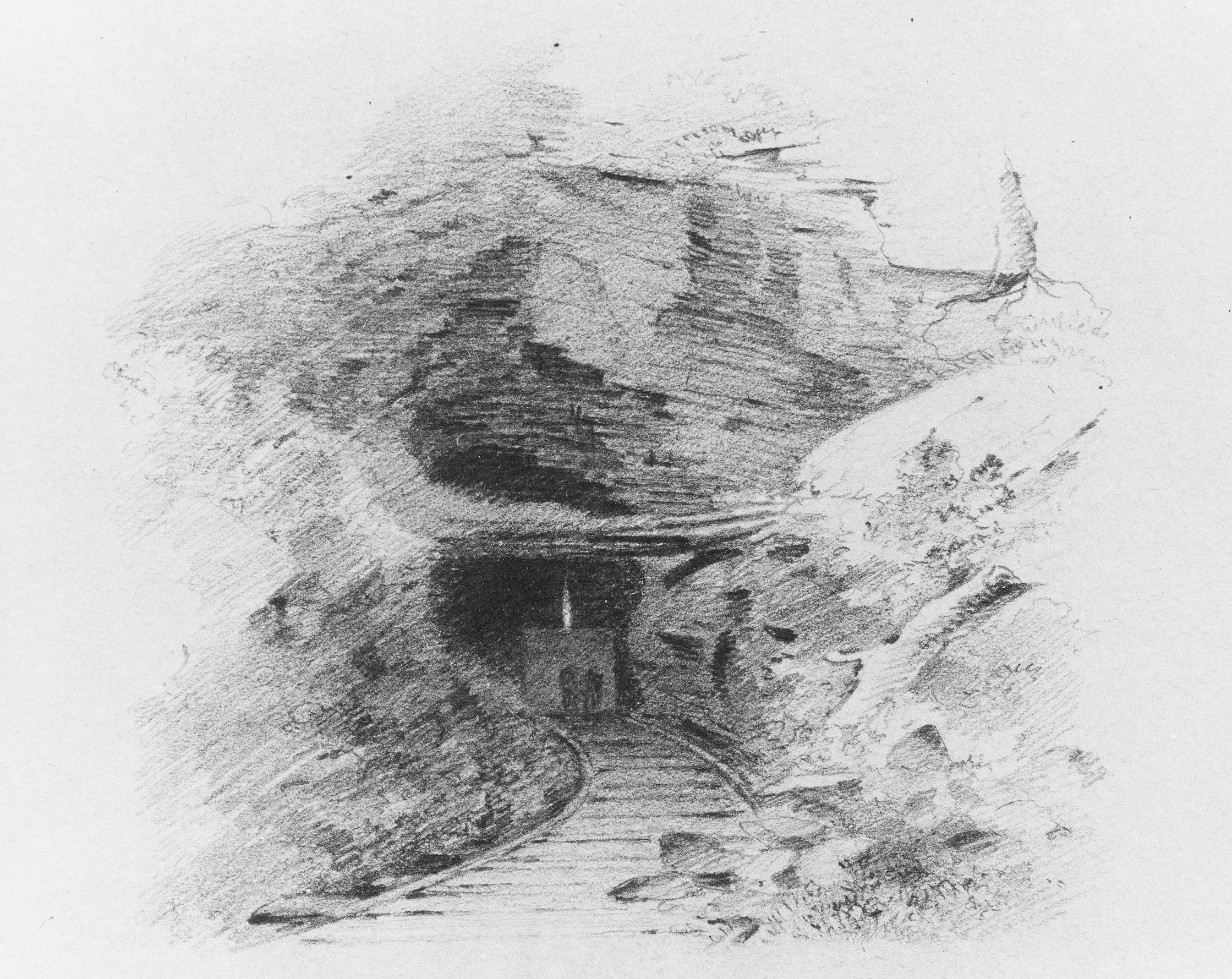
In the case of the paleotechnic phase, the characteristic materials are coal and iron. The major inventions are the steam engine, the railroad, iron, and steel.
The mine in particular is essential for Mumford, as it drives innovation in other areas and shapes human life. Things like the pump, locomotive, railroad, elevator, and subway derive from mining. These are technologies that still shape our lives to this day—imagine visiting New York or London without a subway system or living in a ten-story apartment building without an elevator. These were developed in a kind of feedback loop. The mine made coal cheaper; cheap coal drove demand for coal; new tools were needed to dig deeper and extract more coal; more coal was available and its use increased; new technologies were needed to dig even deeper. Thus, Mumford calls this era ‘Carboniferous Capitalism.’
This also changed our relationship to labor. The mine is an extractive system—just visit West Virginia to see how it’s doing. It takes something of value and moves it somewhere else to be used; often, the place where something is mined benefits only for a short time, during the initial boom. (Here in Texas, we still talk about ‘boom towns,’ driven by the oil industry.) Workers, Mumford tells us, rarely benefited; in fact, he claims that their standards of living worsened. Labor was treated as a ‘new natural resource’ which could itself be abstracted and moved about, benefiting the already wealthy. Mines concentrated labor power, and the handicraft worker and the artisan soon became the next miner—along with women and children. Midway through the chapter, Mumford calls this the ‘widespread starvation of life:’ people ate less well, were poorer, lived in dirtier and less healthy cities.
Why did they tolerate this? Mumford’s explanation is two-fold. First, there was the idea of progress: things were new, they must be better:
Assuming that progress was a reality, if the cities of the nineteenth century were dirty, the cities of the thirteenth century must have been six centuries dirtier: for had not the world become constantly cleaner?…If the workers of the new factory town were ignorant and superstitious, then the workers who produced Chartes and Bamberg must have been more stupid and unenlightened…these facts did not even occur to the exponents of Progress as possibilities for investigation. They were ruled out automatically by the theory itself. (T&C, 183)
Was this true? This is a case where I wish Mumford would provide some evidence; there are few proper nouns in the entire section, and no attributions to anyone who espoused this. We should be skeptical. That’s not to say that Mumford is wrong here, but there is a lot of statements and very little argument from 182 to 191.
The second part of the explanation is more credible: the rise of a Malthusian-Darwinian explanation of class difference. This pseudo-evolutionary explanation of poverty, founded on a limited view of humanity’s ability to sustain a very high population, provided a too-convenient rationalization for the fact that some people were becoming extravagantly wealthy while others toiled. This was nature taking its course.
The Mathus-Darwin doctrine explained the dominance of the new bourgeoisie, people without taste, imagination, intellect, moral scruples, general cultural or even elementary bowels of compassion, who rose to the surface precisely because they fitted an environment that had no place and no use for any of these humane attributes.
A theme throughout Technics & Civilization, and especially prevalent in this chapter, is an increasingly abstract and quantified approach to human life. This is also a feature of the paleotechnic phase. I want to draw a connection between this idea and a book we read earlier in the year: C. Thi Nguyen’s The Score. Nguyen’s major idea is that quantified metrics lead to value-capture, where a quantified proxy of our initial values takes over, so that we end up caring about what we measure rather than what we originally valued—sometimes, we don’t even know that it’s happening.
Mumford writes:
In this paleotechnic world the realities were money, prices, capital, shares: the environment itself, like most of human existence, was treated as an abstraction…The values of the paleotechnic economy were topsy-turvy. Its abstractions were reverenced as ‘hard facts’ and ultimate realities; whereas the realities of existence were treated by the Gradgins and Bounderbys as abstractions, as sentimental fancies, even as aberrations. (T&C, 169)
Perhaps this too justified ‘progress,’ even when the world seemed dirtier and uglier than before; the things that were valued (capital, share prices) kept increasing, and these abstractions were treated as reality while reality was treated as an abstraction.
I want to highlight a few comments from last week’s discussion.
Matt wanted to talk about mirrors:
It occurs to me the evidence for Mumford’s “mirror” thesis could be found in literary and art history. How people wrote about or portrayed themselves might be correlated to the development and spread of mirrors. For example, Shakespeare’s sonnet 3 uses three images of glass (mirrors and windows) in a poem about how we’re going to die and only live through our children (more or less). Is this evidence of introspection? I’m not sure. People have been thinking about dying for a long time.
I also googled around and found a couple of books that could shed light on this: “The Mutable Glass” by Herbert Grabes and “The Self Portrait: A Cultural History” by James Hall.
The description of Grabes’ book reads in part:
“This 1982 book was the first major and comprehensive survey of mirror-imagery to be found in medieval book-titles and English literature from the thirteenth to the end of the seventeenth century... Professor Grabes not only traces the shifting historical usages of the mirror (as the metaphor’s ‘vehicle’) but also studies the metaphor’s structural function in individual works... by investigating the function of a metaphor central to literature over a long period of time, he reveals the interplay between cultural history, the changing attitude towards life and the world, and literary imagination.”
The introduction to “The Self Portrait” says that “Conventional wisdom has it that... good quality crystal glass mirrors... [led to] the irresistible rise of self-portraiture.” But it later discounts that idea, writing “[d]evelopments in mirror technology are largely irrelevant, and this ‘mirror myth’ has clouded discussions of [self-portraits].”
Because of Matt’s comment, I read portions of The Self Portrait. I found a few things. First, Mumford’s claim that it was Venetian glass that facilitated portraiture and thus introspection is wrong—Hall points out that many of the portraits done during the eotechnic phase (Hall doesn’t use the term, but the dates line up) were done with older mirrors, which were developed in the medieval period. Hall also points out that exhortations to introspection are very old; he gives Plotinus as an example, and I think Augustine’s Confessions is another good example.
I also investigated Mumford’s claims about Rousseau. Rousseau, as best as I can tell, did not paint any portraits; Mumford’s description of him as a portraitist is false. Rousseau did, however, help in the early development of the psychological novel with Julie, though calling him the father of the psychological novel is not right; we have earlier examples, like Pamela.
It seems that mirrors, at least of the kind Mumford was interested in, were not a great drive toward introspection. (Walther, another commenter, also mentioned that the story of Narcissus is very old! And he used water!)
Enthusiam Girl wrote:
So I am just going to throw this out there because the thought is currently delighting me and I wanted to share it.
But as much as we make fun of some of the wildest imaginings going on during the 18th and 19th century of the future - the idea of people strapping wings to themselves and trying to fly or envisioning whole civilizations existing on the moon or theories that there was a Hollow Earth with an advanced species living inside of it with their own whole world?
Imagine, for a moment, being Leeuwenhoek. Imagine using a piece of glass to look at really small things - probably just imagining that you might see the indentations on a grain of sand and the erosion more clearly or that you might discover more about what something is made of - and then suddenly instead finding yourself looking at enormous numbers of teeny tiny monstrous creatures instead who are there even though you can’t see, feel or otherwise detect them. Who seem to defy most of the rational hypotheses at the time and otherwise would have seemed unprecedented.
Suddenly the craziest stuff that other people afterwards came up with doesn’t actually seem that implausible.
One of the things I appreciate about Mumford is that he really (maybe even without meaning to) emphasizes the degree to which we actually can’t know what we don’t know. And so our approach to technological advancement needs to really leave room for imagination! In a way that weirdly, despite technologists’ devotion to science fiction, it often lacks.
There isn’t an argument here, so I don’t have critical comments. But I share the sentiment! There is something inspiring about reading Mumford and having to walk through the slow history of technological development, especially when new areas of exploration suddenly open up. Imagine what it was like seeing the first bit of bacteria! It must have been wondrous.
And from Rohan:
I think Mumford's insight that a new technology doesn't get adopted out of nowhere, there needs to be an economic and socio-political foundation for its adoption. Take the mechanical clock as a case. It was not that suddenly our lives became mechanically rhythmic, Mumford points out, but it was already so, at least in the monasteries. Now, I'm not familiar with European history to that extent to verify this, but if it's true, then we need to change how we criticise a lot of present-day innovations. We have to approach them from multiple angles; this would imply that there is no solution but many solutions that might need to be applied in various proportions at different times by different people.
Yes, this is a good part of Mumford. Mumford is (perhaps implicitly) arguing against a ‘great man’ or ‘great inventor’ theory of history; he’s pointing out the ways that old technologies are slowly adapted through a long process. We talked about this a bit in the call on Friday, but this surely impacts how social norms form, too. A brand-new technology is disruptive to norms and could be met with resistance. A technology whose presence slowly grows may more subtly shift our norms and values.